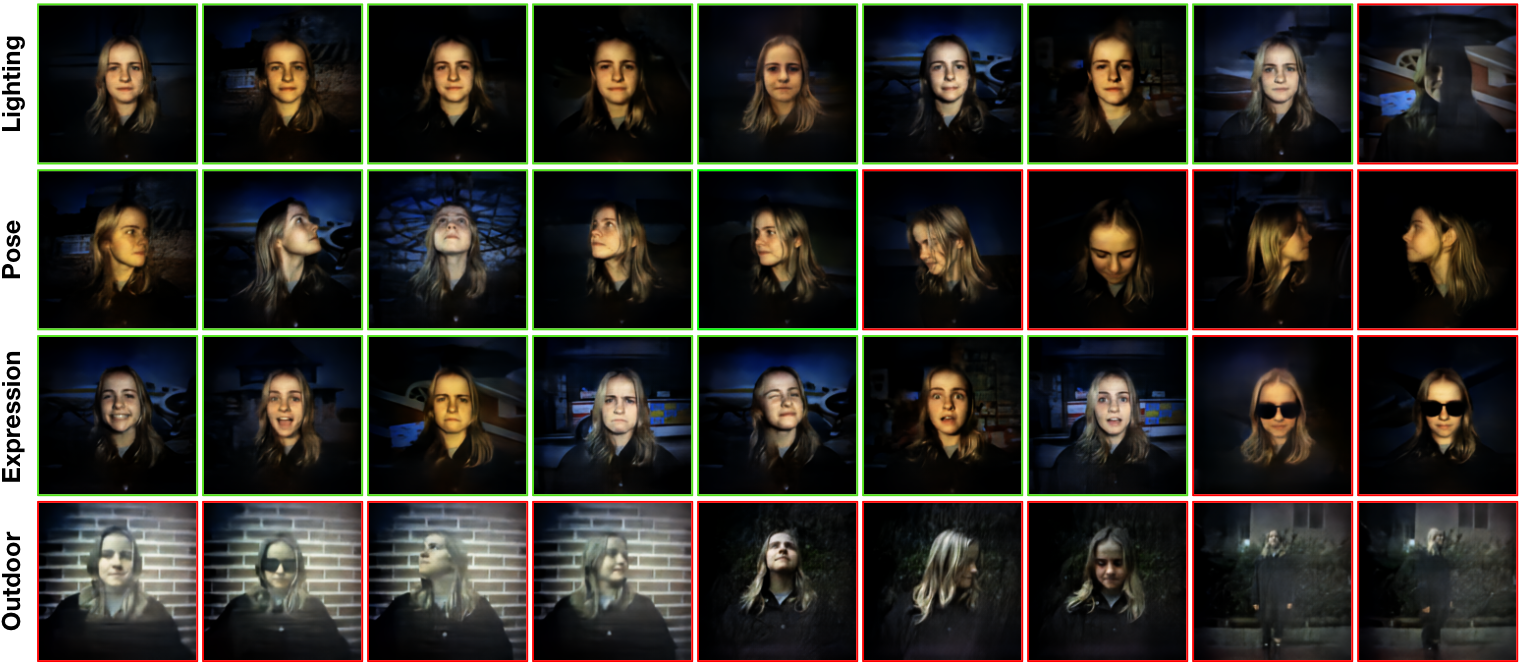
Face recognition is a ubiquitously used computer vision task with applications ranging from everyday smartphone biometrics to high-stakes security systems. Most face recognition systems rely on traditional cameras, which often suffer from limitations such as bulky form factors, high costs, and limited privacy protection. To address these limitations, lensless cameras have emerged as an alternative. Lensless cameras use thin optical encoders instead of lenses, enabling smaller size, lower cost, and greater design flexibility. These cameras are typically paired with reconstruction algorithms that convert raw captures into recognizable images. However, reconstructed images often contain artifacts, and the reconstruction methods struggle to generalize well to real-world conditions. Furthermore, existing face datasets do not account for the artifacts present in lensless images.
To address this issue, we introduce the Lensless Face Dataset (LFD), a large-scale, real-world lensless face dataset. LFD comprises 21,080 lensless raw measurements, reconstructions, and standard images of faces captured under diverse lighting, angle, and distance. Our key contributions are: (1) Real-world lensless face data: LFD focuses on capturing a diverse face dataset with varying levels of artifacts introduced under different environments; (2) In-the-wild captures: 4,976 images are captured in outdoor settings with varying intensities of natural light and different background patterns; (3) Multiple lensless devices: LFD includes face images collected from three different types of lensless cameras, each with a unique optical encoder mask. We use this hardware diversity to demonstrate generalization across different lensless imaging devices, making it a valuable dataset for advancing lensless face recognition.
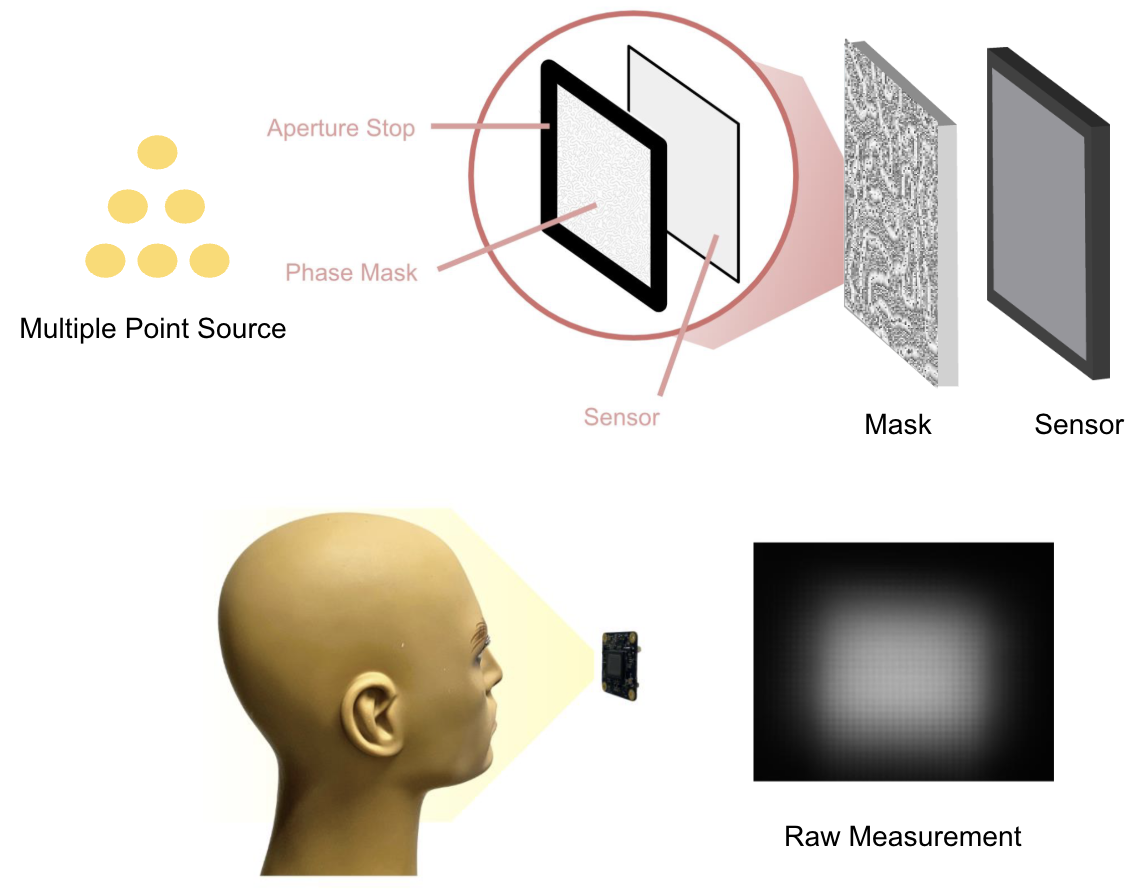
A mask-based lensless camera replaces the bulky focusing lens with an ultra-thin optical encoder — here a contour-based phase mask placed roughly 1.95 mm in front of the CMOS sensor, with an aperture stop that keeps the encoded pattern within the sensor's dimensions. Because there is no lens, every point in the scene is not focused to a point but spread across the sensor as the camera's point spread function (PSF), so the raw measurement is a multiplexed projection of the whole scene with no locally intact structure — a face is simply not visible in it. This is what makes the design thin, cheap, and inherently privacy-preserving, and also what makes recognition hard: the image must first be computationally recovered, and whatever artifacts that recovery leaves behind are what a downstream face recognition model has to live with.
Indoor captures were collected in a fixed laboratory rig where a lensless prototype and a reference webcam sit side by side on the same optical rail, so every lensless measurement has a paired standard image. Illumination was varied deliberately using five light sources — right, front, left, far right, and ceiling — combined into nine distinct lighting conditions, while a 75″ monitor behind the subject displayed random MS-COCO backgrounds to decouple identity from scene content. For each lighting combination, subjects rotated through 10 evenly spaced head angles (~35° apart, including extreme profile views), five expressions, and a sunglasses occlusion condition, at camera distances of 30–50 cm. Outdoor sessions followed the same protocol without artificial lighting or the monitor, at two locations — a brick wall and dense foliage — plus standing captures at 100–120 cm facing six directions. All procedures were approved by the Institutional Review Board with informed consent from every participant.
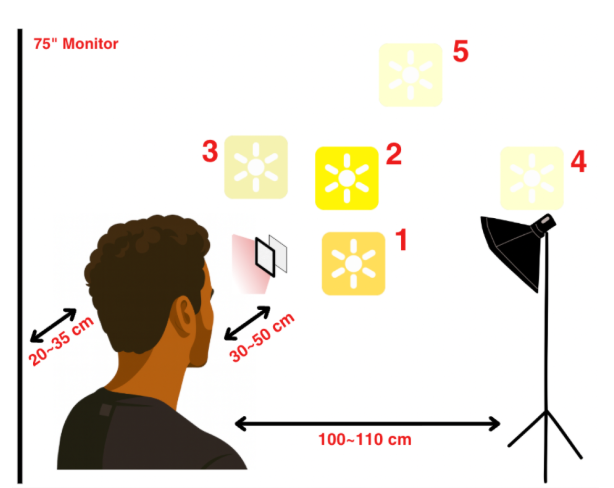
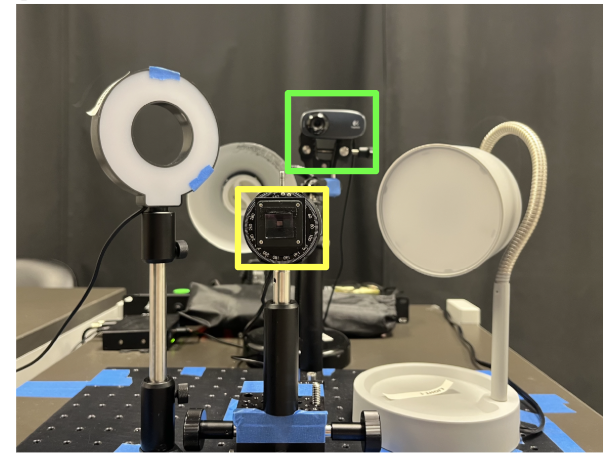
Indoor capture geometry (left) and the physical rig (right), with the lensless prototype boxed in yellow and the paired reference webcam in green.
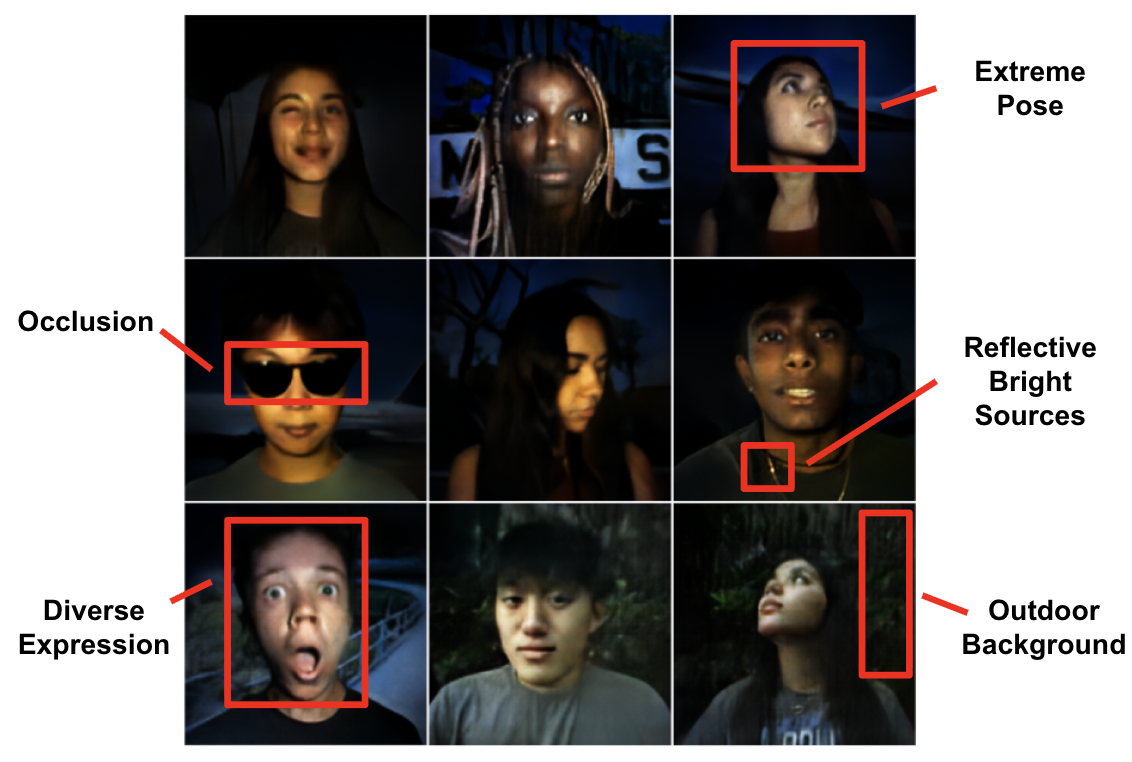
What separates LFD from prior lensless face data is the difficulty it deliberately retains. Reconstructions carry extreme head poses, sunglasses occlusion, exaggerated expressions, low-light interiors, cluttered outdoor backgrounds, and small reflective accessories that saturate the sensor and bleed across the whole measurement. Participants span the full Monk skin tone scale, with the distribution balanced across the training and test splits so skin tone does not confound evaluation. From these conditions we define five verification subsets of increasing difficulty — Indoor Easy, Indoor All, Outdoor, Complete, and Hard — which let a model be scored not just on average accuracy but on exactly which real-world conditions break it.
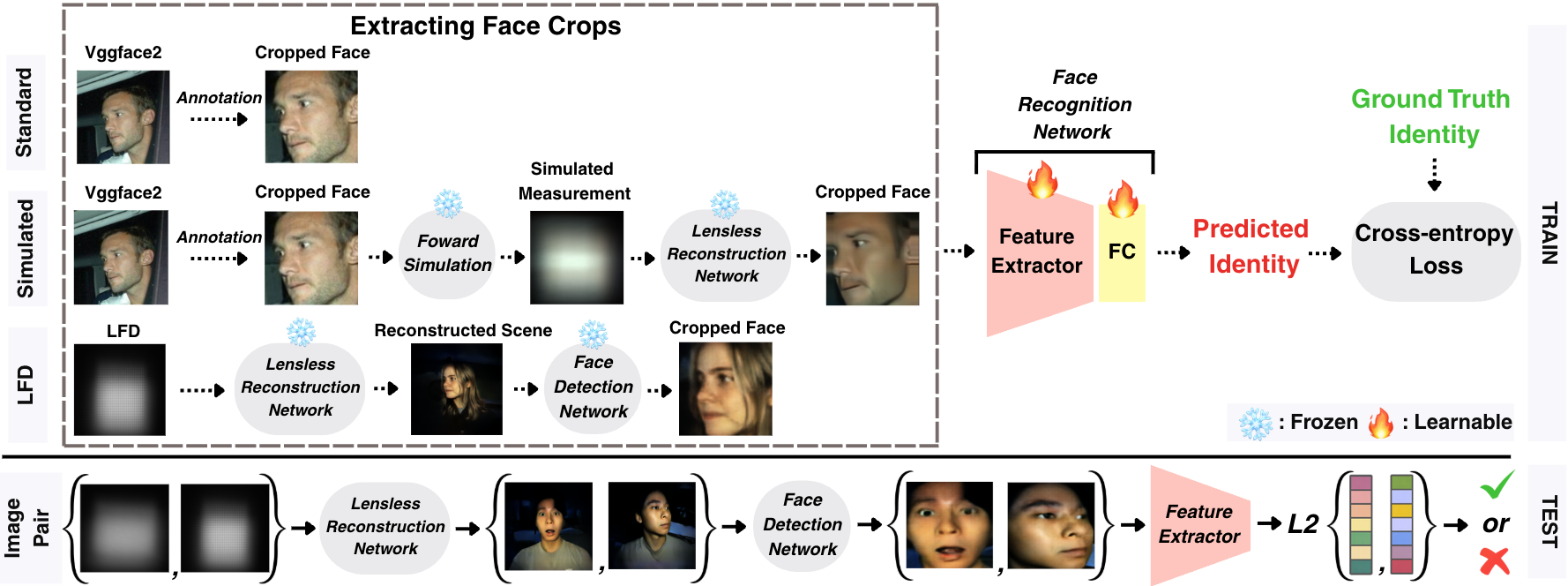
The lensless imaging process is modeled as a convolution of the scene X with the camera's point spread function (PSF) P, yielding the sensor measurement Y = P ∗ X + N. To recover X from Y, we use FlatNet, a two-stage reconstruction network consisting of a Trainable Camera Inversion (Wiener-initialized filter in the Fourier domain) followed by a U-Net perceptual enhancement stage. Reconstructed images are then passed through a Faster R-CNN face detector to crop the face region. Finally, a SENet recognition network, trained with cross-entropy loss on identity labels, serves as a feature extractor at test time — face embeddings are compared via L2 distance for identity verification. All three stages are trained separately; the recognition network is finetuned on LFD training data while reconstruction and detection remain frozen.
We evaluate face verification with ROC curves and Area Under the Curve (AUC), comparing recognition models trained on standard webcam images, on simulated lensless measurements, and on LFD reconstructions. The first row reports Prototype 1 (PhlatCam), the primary device used to collect the training data; the LFD-trained model leads on every subset, and the margin widens exactly where the task gets harder — from 0.947 vs. 0.884 AUC on the Easy set to 0.808 vs. 0.625 outdoors. The second row evaluates generalization to Prototype 2 (PhlatCam), a device with the same mask design but different fabrication and assembly error, and therefore a shifted PSF; the same ranking holds without retraining. In the paper we further show that this transfer extends to a Random Binary lensless camera, a fundamentally different mask design unseen during training, indicating that LFD supports generalization across distinct lensless optical encoders.
Prototype 1 (PhlatCam) — Intra-device Evaluation
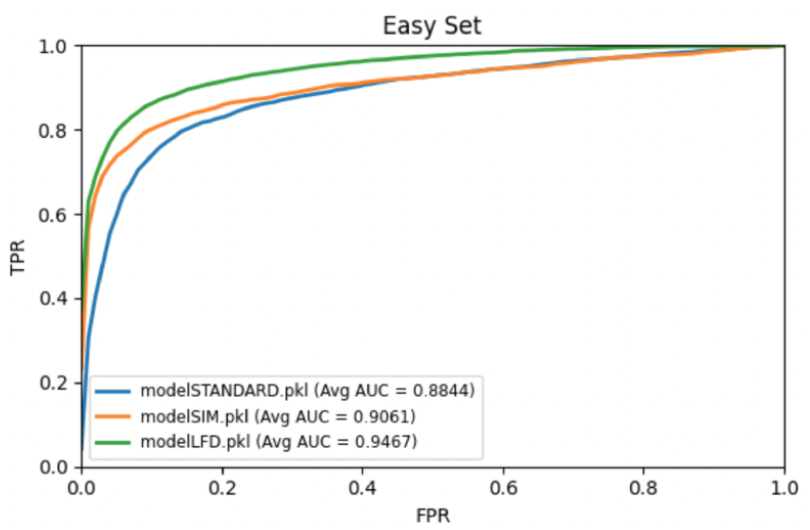
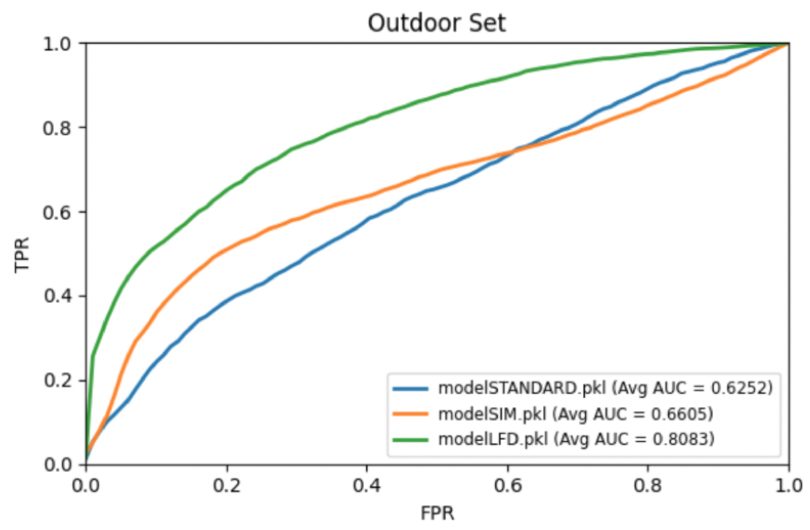
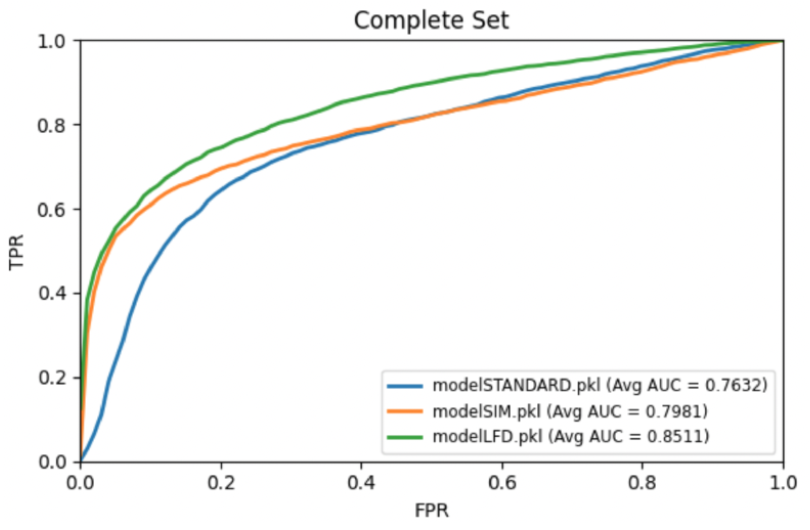
Easy / Outdoor / Complete. LFD-trained AUC 0.947 / 0.808 / 0.851 vs. standard-trained 0.884 / 0.625 / 0.763.
Prototype 2 (PhlatCam) — Inter-device Generalization
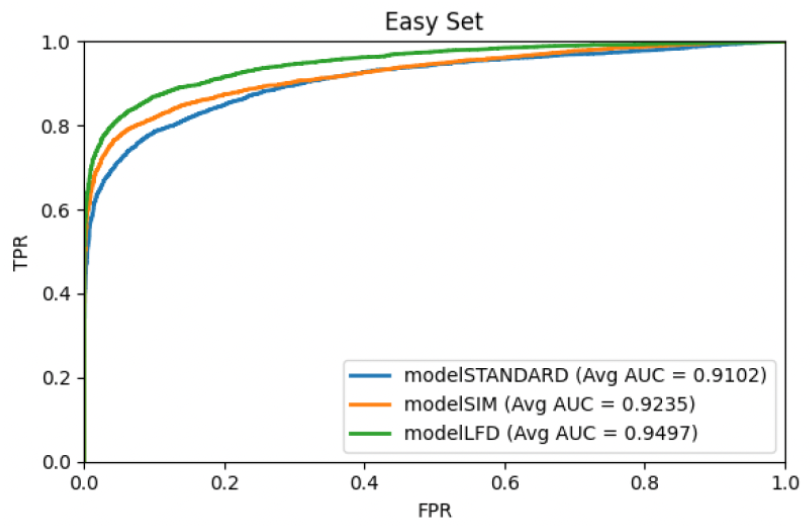
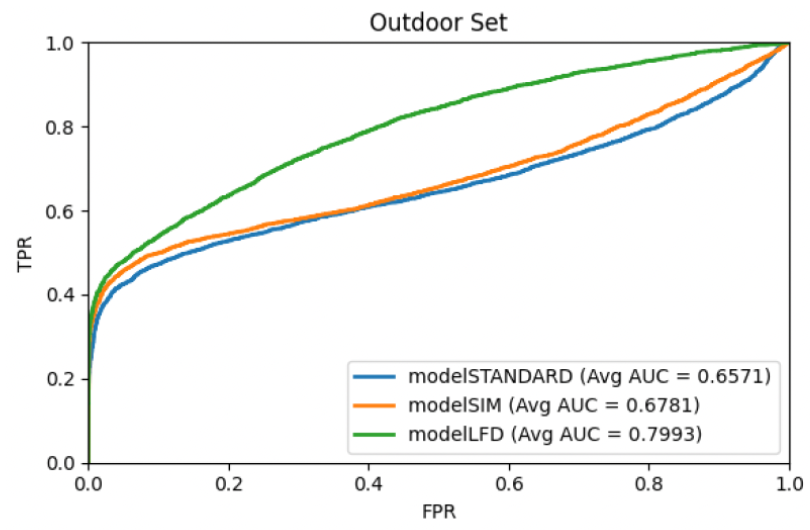
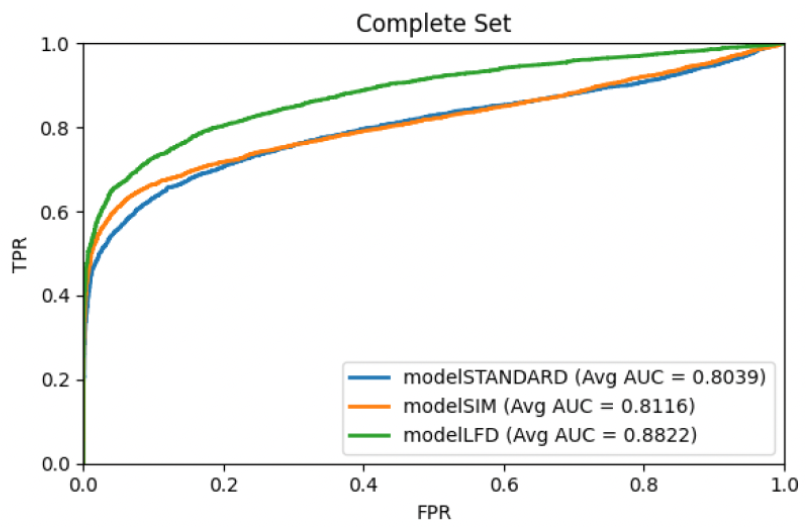
Easy / Outdoor / Complete. LFD-trained AUC 0.950 / 0.799 / 0.882 vs. standard-trained 0.910 / 0.657 / 0.804. Strong generalization across different PSF lensless camera.
@inproceedings{kim2026lfd,
  author    = {Kim, Junho and Khan, Salman S. and Wan, Sara and Kuye, Tomi and Veeraraghavan, Ashok},
  title     = {{LFD}: Enabling Real-World Lensless Face Recognition with a Large-Scale Dataset},
  booktitle = {Proceedings of the IEEE International Conference on Computational Photography (ICCP)},
  year      = {2026},
}